David Levin
David Levin’s photographs document everyday life in Cape Town during a period of profound change. Working in District Six and the Malay Quarter, he produced a body of black and white work shaped by close observation and an understanding of the communities he photographed.
A Record of Place and Everyday Life
David Levin’s work sits within a generation of photographers who recorded Cape Town’s social landscape during the 1960s and early 1970s. His photographs focus on people, street activity and the structure of daily life, made with a direct and careful approach. Produced before the large-scale removals that reshaped these areas, the images now serve as important visual records of communities that no longer exist in the same form.
Biography
David Levin was born in 1938 in Cape Town, South Africa, and developed an early connection to photography through his family. His father, a camera mechanic and owner of the Cape Photographic Exchange, introduced him to the medium at a young age, giving him his first Kodak box camera while still at school. One of his earliest photographs was published in a school magazine, marking the beginning of a lifelong engagement with photography.
After leaving school, Levin continued to develop his interest independently. He later travelled to Canada, where he trained as a television cameraman at the Canadian Broadcasting Corporation in Toronto. During this period, photography remained a personal pursuit, shaped by observation and experimentation rather than formal artistic training.
On returning to South Africa in the mid-1960s, Levin began working professionally. He first joined a commercial studio under Gerald Jacobson before moving into press photography with the Cape Times. During his time at the newspaper, he documented a range of news events, including medical milestones such as the early heart transplant period in Cape Town.
Levin later established his own studio, producing industrial, commercial and magazine work. His career subsequently shifted toward medical photography, a field he entered while working in London. An opportunity to photograph surgical procedures led to further commissions, and eventually to a position at the University of Cape Town Medical School. There, he became part of a centralised medical graphics department, documenting surgical and clinical processes with precision and clarity. This work remained a significant part of his professional life.
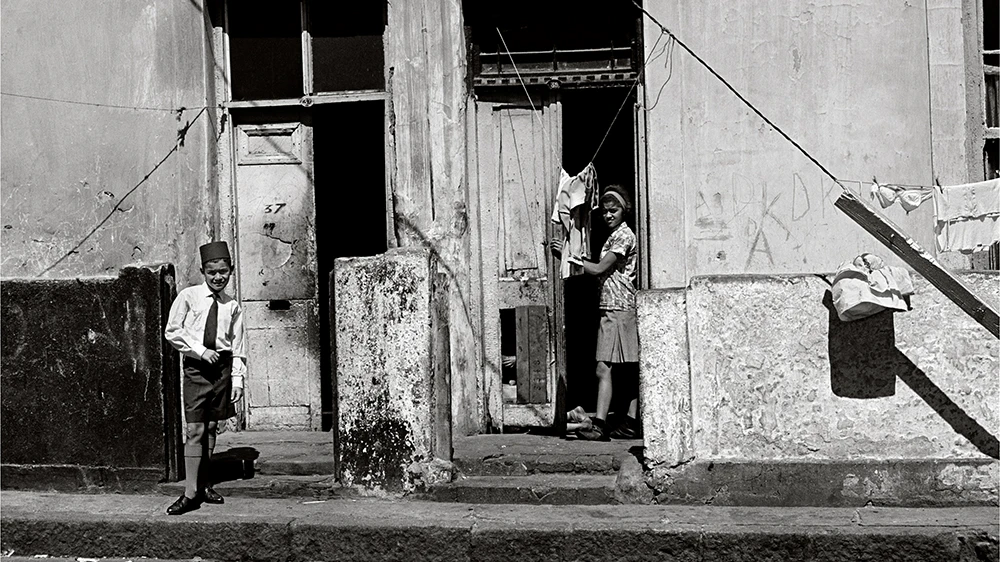
Alongside his commercial and medical practice, Levin produced a body of black and white street photography in Cape Town during the late 1960s and early 1970s. Working primarily in District Six and the Malay Quarter, areas close to where he grew up, he photographed daily life, focusing on people, community interaction and the rhythms of the street. These photographs were made during a period when these neighbourhoods were still intact, prior to the widespread forced removals that would later reshape them.
Levin’s approach to photography was direct and considered. He worked exclusively with available light, composing images carefully in camera, without reliance on post-production. Using Kodak Tri-X film, he processed and printed his own work, maintaining control over the entire photographic process. His images reflect a sensitivity to composition, as well as an attentiveness to the presence and gestures of his subjects.
His photographs from this period were exhibited in Cape Town, including at the Association of Arts, where his work was recognised for its clarity and observational strength. Although not initially produced with exhibition in mind, these images have since taken on historical significance as visual records of communities and environments that no longer exist in the same form.
Levin remained connected to the photographic community of his time, with contemporaries including Walter Firer, Ginger Odes, Beresford McNally and Terence McNally. His work also extended into press and documentary contexts, with selected images shown internationally, including at a World Press Photo exhibition.
In later years, Levin moved away from active photographic practice, eventually stepping back from the medium as it transitioned into digital formats. He later worked as a tour guide in Cape Town, drawing on his knowledge of the city’s history and its communities.
Reflecting on his life, Levin has described a path guided by personal interest rather than convention. His career spans multiple fields, including photography, broadcasting and various independent ventures, but remains anchored in a consistent commitment to work that held meaning for him.
Today, his photographs stand as a record of Cape Town during a period of social and spatial change, offering insight into the everyday lives of people and places that have since undergone profound transformation.

District Six and the Malay Quarter (Bo-Kaap)
This body of work focuses on everyday life in areas close to where Levin grew up. The photographs reflect street activity, social interaction and the structure of community life, made before these neighbourhoods were significantly altered.
Street Photography, Cape Town
Produced during the late 1960s and early 1970s, this series documents life in District Six and the Malay Quarter. The images focus on daily activity, capturing moments of interaction and movement within the street.
Exhibitions and Recognition
Group exhibitions in Cape Town during the late 1960s and early 1970s
Selected works included in international exhibitions, including World Press Photo presentations
Inclusion in international photographic presentations including World Press Photo exhibition
Explore Available Works by David Levin
For availability, pricing and further information on works by David Levin, please get in touch. Each print is produced and handled with a focus on archival quality and historical integrity.