In Conversation with Günther Komnick
Günther Komnick reflects on a life shaped by displacement, visual craft and the quiet observation of people and places.
Gavin Furlonger’s conversation with Günther Komnick is more than an account of a photographic career. It is the story of a life shaped by war, displacement, craft and the gradual discovery of photography as a way of expressing what words could not always hold.
Recorded at Komnick’s home, the conversation moves between personal memory and artistic practice. He recalls leaving East Prussia, surviving a Russian labour camp and rebuilding his life through drawing, lithography, graphic design and photography.
His photographs cannot be separated from these experiences. They reflect a person who learned early to observe carefully, value ordinary moments and recognise the emotional weight carried by small gestures.
A Childhood Shaped by War and Displacement
Günther Komnick was born in East Prussia in 1929. During the upheaval that followed World War II, he was interned in a Russian labour camp with his mother and younger sister. He was still a teenager.
The family spent three years in the camp. Food was scarce and daily life was marked by uncertainty. In the conversation, Komnick remembers how a piece of bread or a simple bowl of potato soup could become deeply meaningful.
Drawing Before Photography
These experiences remained part of the way he understood people. They also help explain the restraint and attentiveness that later became visible in his photographs.
Long before photography became central to his life, Komnick drew. In the labour camp, he made sketches of the people around him, often recording figures living at the edge of exhaustion and survival.
Learning a Craft in the Black Forest
Drawing offered a way to look closely at posture, expression and human vulnerability. It was not simply an escape from his surroundings. It was an early form of witnessing.
After leaving the camp, Komnick travelled through northern Germany and eventually reached the Black Forest. He initially hoped to become a sculptor, but Joseph Bromberger recognised his visual ability and encouraged him to train in lithography.
The Bromberger family welcomed him into their professional and family life. Under their guidance, he qualified as a lithographer and graphic artist, learning the discipline required to construct an image through tone, proportion and careful reproduction.
Beginning a New Life in South Africa
Komnick later worked as a designer in Switzerland. This period strengthened the relationship between artistic expression and practical craft that remained present throughout his career.
In 1956, an advertisement led him to South Africa. He settled in Cape Town and established his own graphic design business, bringing together typography, illustration, composition and photography.
His work and travels took him through Southern Africa, Egypt, the Middle East and Zanzibar. The camera became a constant companion, allowing him to record landscapes, communities and everyday encounters without imposing a dramatic narrative on them.
Observing Everyday Cape Town
South Africa became the centre of a photographic life that would span several decades. His images preserve both the appearance of places and the quieter ways people occupied them.
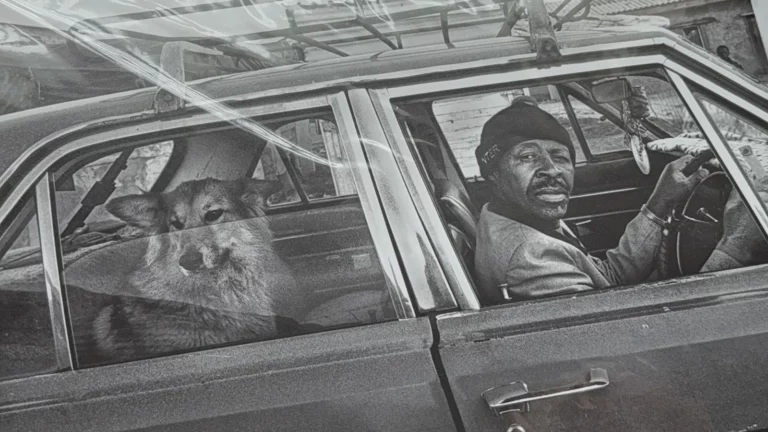
Komnick’s photographs of Cape Town are marked by patience. He paid attention to streets, buildings, public spaces, clothing and movement, allowing ordinary details to carry the meaning of the photograph.
District Six and Historical Memory
His photographs from the 1960s now provide an important visual record of a city undergoing profound social and physical change. The Gallery F feature on Cape Town in the 1960s brings together images that show his measured approach to urban observation.
Among the places Komnick photographed was District Six. His images preserve glimpses of the neighbourhood before forced removals and demolition transformed its physical and social landscape.
A Conversation Across Generations
Seen today, these photographs carry documentary and emotional value. They retain signs of everyday community life that official histories can reduce to dates, policies and statistics. Gallery F’s photographic account of District Six places Komnick’s work within a wider archive of images that preserve the neighbourhood’s human scale, cultural life and enduring memory.
The conversation between Komnick and Gavin Furlonger connects two forms of preservation. One is the photograph itself. The other is the recorded voice of the person who made it.
Viewing and Collecting Günther Komnick’s Work
A photographic print carries both an image and a material history. Its process, paper, condition, signature, edition information and provenance all contribute to how the work should be understood.
Collectors unfamiliar with these details can begin with Gallery F’s guide to editioned prints. Günther Komnick’s available photographic prints can be viewed through the Gallery F store, while further information about individual works and availability can be requested directly from the gallery.
“From there, we escaped after three years.”


Collecting Günther Komnick
Interested in a work by Günther Komnick?
Contact Gallery F for information about available works, editions, print sizes, provenance and pricing.